Sunday, 13 November 2016

Fall Hangar Packing and Cleanup


Saturday Nov. 12th was our fall cleanup and hangar packing day and Pendleton aerodrome was a beehive of activity. An army of members assisted Jarek in packing the hangar with most of the work being competed by 1:00 PM.

An equal army lead by Dan Duclos attacked our wood pile and with the help of the log splitter, managed to fill the triangular woodshed by 2:30.
 
 
By the end of the day everyone was gathered in the clubhouse for another GGC tradition, the bean, macaroni and sugar pie dinner. I don’t think that anyone left the clubhouse hungry! Special thanks to Ray and Marcel for once again hosting this amazing feast.

 
A special thank-you to everyone who came out and helped make the fall cleanup day a resounding success!
Roger

Wednesday, 12 October 2016

The tracker

I've had questions on the Open Glider Network (OGN) tracker receiver.  It is a small computer (Raspberry Pi 3 in my case, though there are others, the Pi seems to be fairly standard), connected to a Software Driven Radio (SDR) receiver, and an antenna, with associated cables. If you live in a noisy (electronically) area, you probably will also need a bandpass filter to cut the noise down.
Cost of a good Pi on amazon, with software images ready to install a version of Linux, Raspbian, is about $100; you can get less powerful Pi's cheaper, but the 3 comes with wireless and bluetooth built in; you have to add that to the others, and they come with a less powerful power supply.
Cost of a SDR can vary; I bought a $27 dollar one (NooElec TV28T v2 USB DVB-T & RTL-SDR Receiver) but it turned out I needed an amplifier, since signals are weak), so I got one with an internal amp on amazon.ca for $19.00 (FlightAware Pro Stick USB ADS-B Receiver).  ADS-B is near the FLARM frequency and can be adjusted for it.  I was thinking of using a spare FLARM antenna I had kicking around, but Nick suggested it wouldn't be enough, so I got a 915MHz 5dBi Outdoors Omni-Directional Rigid Whip Antenna from Mouser.ca for $20.  

The FlightAware 'dongle' attaches to the Pi on USB (4 ports available). Plug a cable into the FlightAware (sma connector) or if you need a bandpass filter, the filter onto the FlightAware, and the cable onto the filter, then coax cable to the antenna. I needed an adapter from SMA to N (standard communications connector) - got one at Active Electronics on Merrivale (also avail at Radio Shack in the US).

There is a good Wiki on setting up the receiver at http://wiki.glidernet.org/ , on the left side "install a receiver".  This is mainly for Euro FLARM (868 Mhz vs our 902-928 Mhz), but Nick B really helped with a set of detailed instructions, which are really cut-and-paste.

I recommend anyone flying with FLARM within range of an OGN receiver register with the OGN devices database at http://wiki.glidernet.org/ddb - it takes only a minute. You need your FLARM id from your flarmcfg.txt file.  I will be doing a post later on how to locate an overdue aircraft using the OGN Search and Rescue function ( http://wiki.glidernet.org/sar ).  Easy and quick - if you're registered.  Your data is held for 24 hours on each flight, then wiped (unless 'locked' when doing a SAR search).

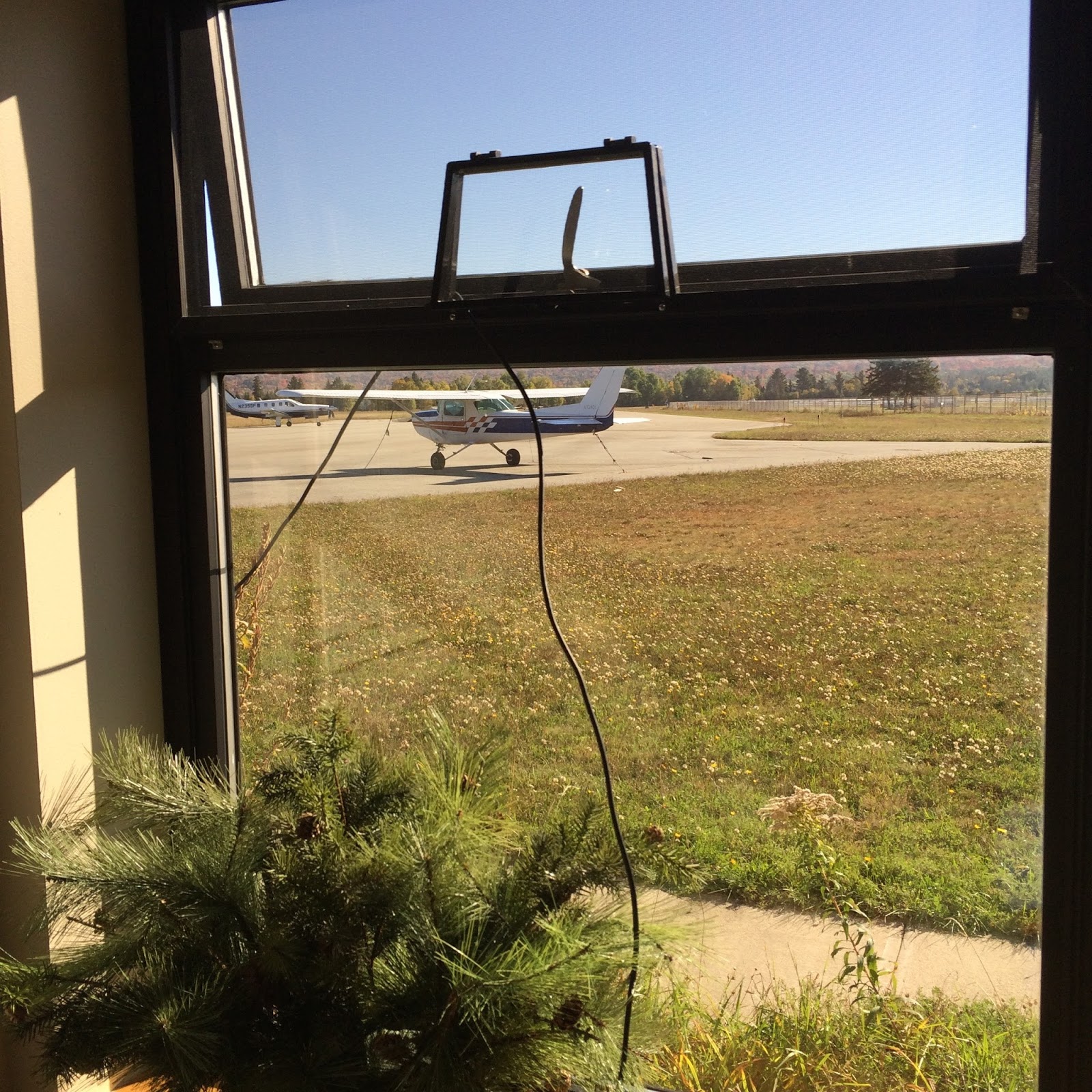
So, what does it look like?  Here are pics of the Pi, FlightAware dongle, the cable from the dongle out the window, then the antenna on a pole. Mount courtesy of Jarek T.; ladder courtesy of Adirondack Air Services (also their pole, wireless connection, and power). The site isn't really ideal, since the peak roof is metal, and shields the area to the North, but the installation works well from Whiteface to Mt Marcy.  
 Pictures:  Pi and FlightAware; cable out window; antenna on pole; receiver range (green squares show good reception); and sample screen of "spot the gliders" from my iphone, looking at DB's data at the time. I get a data point about every 2 secs from gliders within range. Nick and Frank's excellent CNF3 installation on the big Hangar is excellent, seeing gliders in the wave at 8000' at a range of 174 km; my first shot at an installation is basic; I got ranges of about 20 km, and not many gliders went beyond that distance (mountains, wind, etc).  Recall that the transmit power of a FLARM is 0.010 watts (Portable) or 0.018 watts (CORE).  Amazing that it is detectable at all.  I will also get a bigger ladder to put the antenna higher... I have about $140 invested, and am good to go (if you don't need the deluxe package, $70 CAD for the Pi will bring it down about $30).  You will need access to a wireless network.  I will tinker with the setup, and install it again next year at Lake Placid.  The higher you get the antenna, the better; the Pendleton set-up is 30m up...

There are receivers at GGC, RVSS, MSC, SOSA and I believe Champlain clubs.  It makes what we do accessible to the public, and it is a boon for the crew to wander in, look at the screen, and know whether their Sailplane Crew Union Membership (SCUM) duties will be required... You can also watch a race in near-real time, which was very popular at MayFly.  We also discovered a bad FLARM A antenna in the Puchacz installation, which we fixed by using a 1/2 wave dipole antenna.

In the US , there are receivers at Minden NV, Colorado Springs, and when the GGC Lake Placid camp is operational, there (1-10 October).   If the wave is up, and the gliders are above 8k you might see them on the Pendleton or Hawkesbury receivers.

To decrease noise, the pi and dongle should be separated (powered active usb cable works well, I'm told), and dongle and antenna as well (5 loops of 6" in cable also help, as do ferrities).  I did learn that standard coax losses are huge, and will be replacing RG58 (standard cable tv coax) with low-loss coax (probably LM200 or LM 240) to boost my detection range.  The fewer adapters, and the better the connectors, the less loss there is. Jarek and Nick improved my antenna and got a 9 dB gain on Saturday when it rained. We got at least a 10 km increase (no one got terribly far on a wave day - going up instead of out...

My next post will be a look at the October 10th wave, and the one after, using OGN for SAR.  If you want to spot the gliders, go to live.glidernet.org . You can see them in the Andes, Africa, Australia, Europe, and now, North America.

A big Bravo Zulu (navy-talk for good show) to Nick for bringing the first station into life in Canada, and helping techno-bozos (me) to get the thing going. 
Pi, FlightAware (behind PC in flight planning room). Power supply plugged into wall below)

Cable going out a window

5 dB antenna screwed into pole; ground plane added for better gain
Green blob shows glider detections - "it's all about the blob"- circles are 10 km

What it looks like on iPhone 5 screenshot; anywhere there's internet

click on a yellow glider and get info every 2 secs - trails too! Receiver at Lake Placid airport


Monday, 10 October 2016

Sat/Sun

On Saturday, it rained...

On Sunday, it all depended on the amount of moisture; a towplane test flight to Whiteface said there was a hole in the overcast and wave at Whiteface. Several gliders launched - DUO, 2D, 55, ST, DB, IAK - and the early ones got to see the hole close, and overcast get a bit thicker - moisture from Matthew.  The winds allowed ridge soaring on the Sentinel Range; the long wings (ST, DB) tried to get to Algonquin, but it was only 3000 AGL, and marginal, so they returned (they have sustainers, so it was safe).  After a pizza supper, there was a bonfire.

The HRRR shows wave is likely this morning, and after flying we have to dismantle the tracker - which Jarek improved on Saturday, so all flying is likely to be captured on it today - and disassemble the gliders and pack up for the trip home.

The winds are NW, favouring Whiteface, but there is a reduction in speed at 12000 that may be a problem. Regardless, we'll be having a go!

So far, I've had a challenging blue thermal day, and a wave attempt that ended up in Ridge. Will I complete the triple?  Time will tell.

Should increase with height; 9-12k a problem?
orange and green bands are wave just lower left of Lake Champlain (we hope)


About 2500 Bkn - Ovc right now. Rigging and waiting (update).

2D

Friday, 7 October 2016

Friday

It looked on the thermal forecast to be a weaker day than yesterday.  Nick suggested that, with the increasingly stable air and wind direction, there might be wave; only a light breeze on the ground. Jarek took the Pawnee for a look, and there was wave near Algonquin Peak.  A lot of nice flights, with those who invested in a 5,000 or 5,500' tow were rewarded with a few hours of localized wave, and those who took 4,000' tows and released on first bump were rewarded with a tough ride, having to use sparse rotor or slide downhill to the Sentinels to get up.  A couple of very nice flights were flown...  see the OLC.

Saturday looks a bit rainy at midday, with pretty well fully overcast.  That is the front, which will cool it down (quite warm, shorts and t-shirt weather), and on Sunday, swing the wind to NW, which is favourable for wave (if you have stable air).  Time will tell.  The low overnight Sun/Mon is -3C (was +4 last night).

The tracker seems to be working ok.  Tim from RVSS posted a pic on the SAC FORUM of ST thermaling near Whiteface. 

Pic of the MSC Duo Discus landing on the last flight of the day, 6ish.

MSC Duo, final for 32, grass.


Lake Placid - Thursday

The day wasn't as strong as Wednesday, but flights of 3 hours, topped about 5,800' ASL (Lake Placid is 1,745' ASL) were normal.  It started with a few Cu, but turned blue.  Most gliders have FLARM, and anyone with a good climb pretty quickly had a lot of company...

Two photos of my flight, one looking east at the Sentinel range, the other, over Lake Placid, looking out towards the north. You can see a strong inversion.

Today should be similar to yesterday, and we continue preparation for high altitude flights with oxygen fills. Saturday looks rainy, and is the front that should change the pattern to winter (and better wave possibilities).  Highs have been 75F/23C - very nice - but the low on Sunday is -2C.

Sentinels - ridge soared these briefly
Lake Placid, the MacKenzie range, then in the far distance, Canada

Thursday, 6 October 2016

Lake Placid 2016

Quick update. We have an OGN tracker running; it doesn't have the range of the permanent installations at GGC, MSC, and RVSS, but it will allow you to see gliders within 10 miles or so of Lake Placid:
http://live.glidernet.org/#c=44.28043,-73.88772&z=10&l=ar&p=3&u=i Not great quality, since it is a screen shot from my iphone; better on a PC.

Here's an idea of the fall colours in Lake Placid; that's looking east to the Sentinel Range; the staging area on 34; the MSC Duo on final.

 View from the picnic table... nice
We had a bunch of flights, some just short of 300 km (almost to Potsdam NY and return - seen by the GGC tracker at 118km!  Other flights over 5 hrs.  MSC Duo, RVSS Grob, GGC Puchacz all did field checks.  Flights to 6000' ASL, and very calm.

I'm off to fly.


Sunday, 11 September 2016

Sep 9, 10 work

On Friday Sep 9, the Junior was dropped off for maintenance at Bromont.  While it was an okay soaring day, there wasn't enough interest to fly, and a few of the usual suspects were out working on their trailers, and enjoying quite a nice day.

The entrance to the Carpenter Shack has been needed some TLC for a while... after 74 years, the wood beams were very soft. 

Jarek got 3 long 2x12 pressure-treated boards long enough to do an interim fix.  The story in pictures.  Work was about 90% Jarek, 5% Mike, 5% me.  While the punky boards will have to go, probably requiring a small digger (yippee!) rental, and a small concrete pour, and perhaps better drainage, the front of the shop should be ok for a year or two, and we can keep the tractor there over the winter safely. Work finished up late Saturday morning. 

The Carpenter Shack is great for maintenance on gliders, trailers, fabrication, and was used for briefings and scoring at the last National Soaring Contest we hosted; it's a facility that makes a lot of the things the club does a lot easier.  Thanks to Jarek and Mike for their work.

Beams fitted in (2 of 3) to replace punky wood
Using jacks to sister the boards into a beam (Jarek, Mike) to push the rotten wood back
Beams screwed together; blocks to connect to existing structure; plywood
Steel to direct water away from wood
Gravel to keep water away

One hour later, OR trailer under repair, and drive belt temporary installation ongoing (Jarek, Jacques)