Monday, 10 June 2013

A nice day at the club - Sunday, June 9th

While many people amused themselves with a trip to Montreal to view the Grand Prix, members of the club had a very nice flying day at Pendleton.
You might wonder what keeps gliding interesting; it varies. Some like to instruct new people how to fly; some like aerobatics; some like to float around; and some like to challenge themselves to fly the greatest distance for the conditions of the day.
Some of the club members record their flights with GPS flight recorders, and post them to an online contest to compare how they did versus other pilots on the same day (www.onlinecontest.org).  The club has had 40 flights by 13 pilots loaded (a slow start for the year due to the weather) in Canada, with a cumulative distance of just under 8,800 km.  If you include flights in the US, 57 flights by 13 pilots, for 13,162 km - without engines! This puts us 33rd out of 159 clubs in North America (6th out of 24 in Canada).

Here are four examples from Sunday:
Nick, flying ST:

The top is a 2-D picture of the flight.  It was about 440 km long.  The bottom shows altitude, in metres, vs time (Universal - GMT). The green shows how the ground level changes (you can see the Gatineau hills). A flight to the Seaway, then up north of the Ottawa River.
Ron, flying Z9:
On Ron's flight, you can see the sensitive mic picking up the airstream noise on the graph in yellow  - this is designed to detect engine runs in motorgliders.  It was about 356 km.

Ulli, flying MZ:
Ulli started later in the day, but still went 321 km!

Finally, Rob, in one of the two-seaters, had a good flight in CZ.
You can see the drift from the wind as he circled to gain height (this is our equivalent of a gas station in the sky). The wind was from the north-west, up by the Ottawa River, and more westerly south of Pendleton.

On another flight, one of our pilots landed out at an airstrip just south of Maxville, Ontario, in one of the club's high performance gliders, an ASW-24 (it can glide about 10 km per 1,000' of altitude lost). The club sent one of our two towplanes to retrieve the glider from that airfield:
Photos are by Tom Hastie.
 Towplane getting ready to tow the glider at the very nice airstrip.
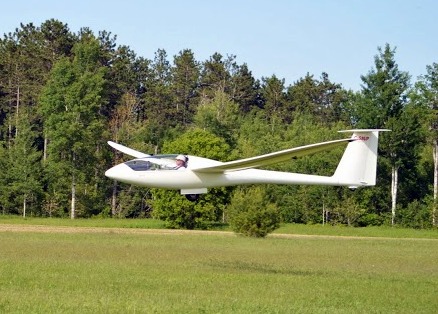
Glider returning to Pendleton.  We are trained and qualified to land at convenient airfields, or farmers' fields, before going cross-country...  the slow approach speeds of the gliders mean you can land in very short fields.

You can also live physics while flying.  For example, atmospheric pressure decreases with altitude... so if you close a water bottle at the airfield (260' above sea level), and open it 4,000' higher, water wants out... as seen below.  Capture from a GoPro video camera...


The club is preparing to host the Canadian National Soaring Championship from 1-12 July.  We hope to have glider pilots from across the country come to select a champion to represent Canada at the 2014 World Gliding Championship in Poland or Finland (two different classes).  We may also get pilots from the US.  Watch this space!

Tuesday, 28 May 2013

Private gliders at GGC - SZD-55

There are a number of privately owned gliders at GGC. One that is popular is the SZD-55, a Polish standard-class (that is, non-flapped) glider with 15 metre span.  It was designed in the late 80's, and has a glide ratio of about 43:1.  It has a distinctive silhouette, with a graceful elliptical wing.  It is fairly light - about 220 kg empty - and is very easy to assemble.

There are 3 at the club:

2D, owned by Dan Daly (outlanding in a field):


AT, owned by Roger Hildesheim (photo by Sonia; also in a field):


A more recent arrival, 55 (contest letters for tail a work in progress), owned by Jarek Twardowski, on final at Pendleton.  Photo by Tom Hastie.  Looking great!


The instrument panel of 2D looks like this in flight (over Ridge Soaring in Pennsylvania):


On the left is an anti-collision system (PowerFLARM), then a variometer (LX V3, shows rate of climb, average climb, speed to fly, altitude), Airspeed indicator, Android phone with soaring software (XC Soar - it is more visible in the air than this photo would suggest), which is higher in this photo than normal so the other instruments are more visible, a stall-warning system (red LED), then, bottom row, another variometer, soaring computer (LX7007), and altimeter. The red handle is canopy jettison, the yellow is the rope release, and the brown is for adjusting the rudder pedals.  Just below is a microair radio.

The anti-collision system is new, and this is the first analysis of how well it is working - an average 5 km range with other fitted gliders:


I will post information on other privately owned GGC gliders from time to time.

Dan
2D


Sunday, 26 May 2013

Waiting to Clear!

Sunday started off pretty dreary with mist and rain for most of the morning. But like the old saying, good things come to those who wait, things cleared out and by 3:00 we had 3 kt thermals and high CUs!

Although most folks had called it a weekend and left early, Andrew and Ulo had a fun flights with guests and Nick and Christine got re-acquainted with Eastern Ontario soaring by going for a flight in the Puchacz. Now the only remaining question is:


What exactly are these guys looking at?

Cheers,
Roger

Wednesday, 22 May 2013

MayFly 2013 Wrap-Up


As I sit here today writing up a summary of the 2013 MayFly competition while looking out the window on a rainy day, I am still grinning about the flights of this past weekend.  Over 5700 km, flown by 12 pilots in two days.  What a contest!


This past weekend saw some of the best soaring conditions ever in eastern Ontario for the MayFly contest.  XC speeds hovered around the 90km/h mark on Friday and busted through 100 km/h on Saturday. Many pilots achieved personal best speeds, without water ballast. A screen capture of all the Saturday (Day 2) flight traces (below) tells the complete story. The sausage dinner on Saturday evening ensured that hangar flying sessions continued late into the night.


 In keeping with the MayFly mission, we held a very constructive review/analysis of flights using SeeYou on Sunday. Special thanks Ulli and Joerg for sharing their insights regarding competitive and XC soaring. I can honestly say that the Sunday flight review (it was really more like a class…) was one of the most informative and interactive sessions in recent memory.

Daily and overall scores are posted on the GGC MayFly Site. Thanks to Sonia for scoring and Nick for updating the scoring program.


1st Place - Pierre Gavillet (PG)
2nd Place - Team M7 (Martin Lacasse & Paul Goyette)
3rd Place - Dan Daly (2D)


To all the pilots who participated in MayFly, you conducted yourselves in a most professional manner and demonstrated exemplary airmanship. It was a pleasure to fly with you all.

Bravo-Zulu!
Roger

Thursday, 16 May 2013

Back Online!

After some website updates and general E-cleanup, "This Week @ GGC" is back online.
Watch this blog for reports from our 2013 MayFly competition and glider meet that runs from May 17th to May 20th.
For more information on MayFly, follow the link below:
 2013 GGC MayFly Competition
 See you at the Aerodrome!

Sunday, 3 April 2011

2011 Season Underway

From Wolfgang...

When I arrived at Pendleton today I noticed our old Puchacz trailer was parked at the carpenter shack, with C-GJCZ inside. Thanks Jarek for bringing it home. The fuselage is now in the workshop and we are preparing it for inspection by the TC delegate and our club AME.

On a flying note, today we had thermals with strengths up to 6 kts, beautifully strong spring thermals. Come out to fly. (Editor note: you know the thermals are strong when you perform a two rotation spin followed by a spiral dive...as part of the spring checkout...and end up 500 ft higher than you started!)


From Jean-Marc...

Yes, GGC is the proud parent of a glistening preemie named Zulu.

She is a beautiful Bubo Bubo (read on), granddaughter of our venerable Puchacz, shown here at the start of the 2007 season, ready to spring into action.
The family name, Puchacz, actually means Eagle Owl, which scientific name is Bubo Bubo (ours was a Canadian Bubo Bubo).
This species has been known to soar on updrafts, unusual for an owl. It can live for 20 years in the wild and has no natural predators. Man-made causes are the leading cause of death.
So, after mourning our Puchacz during the winter, I had the pleasure this morning to witness the hatching of a new one in the expert hands of Wolfgang Weichert, who exhibited all the temperamental traits of an expectant father.
The most difficult part of the whole operation was actually moving the egg to the delivery room.
Then, everybody was so excited to find out what was hiding in the shell that assisting the hatch was not a difficult decision.
Wolfgang was quick to brief everybody on how to deal with a breech birth. All hands were called on deck to pull out this tall baby.
Once it saw the light of day, it became obvious to everybody that there was no down on this bird, so Wolfgang decided to put it in our brand new incubator.

That gave us a chance to admire her more closely.
If only babies could come with an owner's manual .
Thanks for the new addition to the family Wolfgang!

JM

To see a real Puchacz hatching, check this out:

http://www.youtube.com/watch?v=z-J-Y2fvaw8

http://www.youtube.com/watch?v=oCF5F3WOK0Y&feature=related

And then, for the grown up version landing:

http://www.youtube.com/watch?v=LA6XSrM0V_0&feature=related

Cheers,
Roger

Sunday, 27 September 2009

"Illusions" & GGC History

It is sometimes said that life is not a destination but rather a journey and that things usually come full circle. One of those things came around full circle in Lake Placid this past weekend.

The past 2 weekends have provided pretty good mountain flying conditions for those intrepid aviators for GGC, RVSS and MSC that wanted to get a jump on the wave camp fly week but nothing prepared me for the visitor we had at the end of the day Saturday. After being kicked around in mixed wave/thermals conditions for most of the afternoon the KLKP glider pilots were treated to some fine “18m span eye candy” with a visit of a 1938 snapshot of how to build an 18m span aircraft (well, 18m spread across two wings that is...). Jim Catalano dropped by in his “better than new” Fleet model 16 biplane (better known as a “Finch” to those of us in Canada). To new members of GGC your first reaction may be “cool” but where is Roger going with this…stay with me…

Back when Pendleton aerodrome was established as a home for #10 Elementary Flight Training School (EFTS) for the RCAF in 1942, the aircraft used for training where Tiger Moths and Fleet Model 16s (Fleet Finch). Kind of interesting now that GGC has started to make a pilgrimage to LP for a fall wave camp that one of the ghosts from RCAF and GGC history is lovingly cared for and flown by a local LP pilot.

For those Richard Bach fans, the Fleet Finch (powered by the famous Kinner B5 engine) is the type of aircraft that he flies in his book titled “Illusions”.

The photos say it all…

Cheers,
Roger